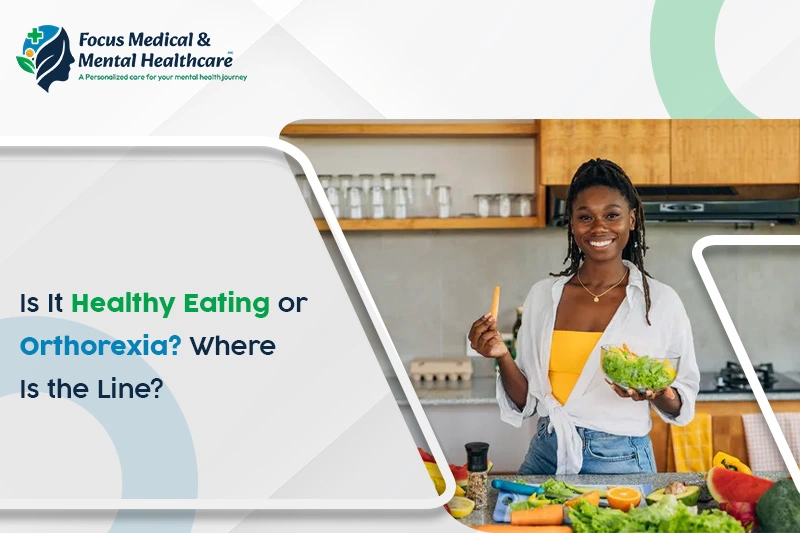
Many of us try to eat well to feel good and stay strong. But when rules about “clean” food take over your life and cause deep fear or worry, it might be a problem called orthorexia.
If food concerns affect your daily life, a professional evaluation at Focus Medical and Mental Healthcare Inc. can help identify the root of the issue and guide appropriate care.
Let’s explore the difference between normal healthy choices and an unhealthy obsession with food.
What Is Orthorexia?
Orthorexia means having an extreme obsession with eating healthy food. People with this issue do not focus on being thin, as in some other eating problems. Instead, they want their food to be perfectly clean and pure.
They might stop eating whole groups of food, like all sugar, milk, or bread. At first, it just looks like they are trying to be fit.
But soon, the rules get too strict. They might spend hours reading food labels. They get very scared of eating anything they think is “bad.”
This deep fear hurts their minds and bodies, turning food into a strict test instead of something fun and tasty.
Is Orthorexia a Recognized Eating Disorder?
Not yet. Orthorexia is not recognized as a distinct eating disorder in the DSM-5, which is the manual that doctors use to diagnose mental health disorders. That doesn’t mean it is not real.
The National Eating Disorders Association considers orthorexia to be a growing trend and it is classified as a variant of anorexia nervosa or obsessive-compulsive disorder by many experts.
The lack of a formal label makes the “line” harder to see, but the harm is still measurable.
What Does Normal Healthy Eating Look Like?
To see the difference, we must look at normal healthy eating. A healthy eater makes good choices most of the time. They might pick a crisp apple instead of candy for a snack and try to eat green vegetables with dinner.
But a healthy eater is also flexible. This means they can bend the rules without getting upset.
If they go to a friend’s house for a pizza party, they eat the pizza and have a great time. They don’t feel guilty the next day. Healthy eating brings colorful, vibrant energy to your life without taking it over.
What Makes Healthy Eating Cross the Line?
The difference is not the food itself. It is the cost of the food rules. A helpful question is: What is your healthy eating taking away from you?
Healthy eating contributes stability, confidence and energy. Orthorexia frequently loses flexibility, fun and connection. The transition occurs when there is an increasing fixation on food rules, fear and a sense of social isolation.
Ask yourself these questions:
- Can you eat a meal someone else cooked without panic?
- Do you feel guilty or anxious when a “safe” food is not available?
- Have your food rules caused conflict with family or friends?
- Do you spend hours a day thinking about food, labels, or future meals?
- Does your self-worth rise or fall based on how “clean” you ate?
A “yes” to one question does not mean you have orthorexia. A pattern of “yes” answers, especially when the rules keep tightening, is worth paying attention to.
What Are the Warning Signs of Orthorexia?
Orthorexia can look like discipline from the outside. From the inside, it often feels like fear. Common signs include:
- Compulsive label checking. You read every ingredient list and nutrition panel, even for foods you buy every week.
- Food group elimination. You keep cutting out more foods or whole food groups, not for a medical reason, but because they feel “unclean.”
- Distress when safe foods are missing. You feel anxious, angry, or panicked when you cannot control the food available.
- Social withdrawal. Skips dinners, birthdays and travel because food will not abide by your rules.
- Perfectionism around food. You notice you think you ate better than others. You find yourself feeling good about your diet, or not accepting people’s way of eating.
- Body image may or may not be involved. Orthorexia also isn’t necessarily about weight or body shape, as with anorexia. Purity and Health are emphasized.
What Are the Health Risks of Orthorexia?
A diet that looks “clean” can still leave the body undernourished. When entire food groups are removed, key vitamins and minerals can drop. The physical and emotional costs include:
- Nutritional deficiencies and malnutrition
- Low heart rate and digestive problems
- Anxiety and guilt around food choices
- Social isolation and conflict with loved ones
- Loss of pleasure in meals and gatherings
The heart of the problem is not nutrition knowledge. It is the rigidity of the rules and the anxiety that keeps them in place.
How Does Mental Health Connect to Deep Food Worries?
Anxiety is these worries about food. To be very frightened or nervous is to be anxious. This intense anxiety can cause sadness, and you may feel very alone.
That’s why it is critical to consult with a mental health professional. Don’t suffer from these anxieties alone. You will be able to find a balance again and feel better once you are in the hands of caring professionals.
How Is Orthorexia Treated?
There is no single treatment designed only for orthorexia. Most care follows the same path as anorexia nervosa or OCD. A multidisciplinary team often works best, including a physician, a therapist and a dietitian. Treatment may include:
- Cognitive behavioral therapy (CBT), especially exposure and response prevention, to reduce food-related obsessions
- Nutrition counseling to gently expand food variety
- Meal coaching and support with feared foods
- Medical monitoring for deficiencies and physical health
- Medication management when anxiety, OCD, or mood symptoms are present
At Focus Medical and Mental Healthcare Inc., care begins with a comprehensive psychiatric evaluation to understand your full picture. From there, our team offers medication management, anxiety treatment and telepsychiatry for both children and adults.
Our goal isn’t to shame your food choices, but to help you build a flexible, nourishing and fear-free relationship with eating.
Ready to Find True Joy in Food Again?
Food is meant to be enjoyed. It brings families together and fuels our bodies. If strict food rules have stolen your joy, it is time to take it back. Healthy eating should make your life bigger and brighter.
If your world has become too small because of diet restrictions, please reach out to us today. Book an appointment online or call us at (913) 980-8179. Together, we can help you find true balance.
FAQs
Can orthorexia affect children?
Yes, children and teens can develop deep worries about food. Focus Medical and Mental Healthcare Inc. treats children starting at age 10.
Does orthorexia always involve body image concerns?
No. Unlike anorexia, orthorexia is often driven by a desire for purity or health rather than weight loss. Body image concerns may or may not be present.